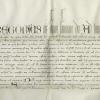
Papal Bull, issued by Pope Gregory XI, Avignon, France, 1373 (image 1 of 2)

Description
A Papal Bull is essentially a written communication, issued by a pope, usually detailing the granting of privilege, or issuing instructions of some kind. A formal letter, delivered open, the bull takes its name from the lead seal, or 'bulla', attached at the bottom as a means of authentication. Until the 11th Century, bulls were written on papyrus, and so few early examples survive. Later examples, on parchment or vellum, have survived in better condition.
This example was issued by Pope Gregory XI, in 1373, in support of the Friars of La Scarzuola. Born Pierre Roger de Beaufort in 1331, Gregory XI was the last of the Avignon Popes, returning the Holy See to Rome in 1371. Avignon had been chosen as an alternative see in 1305, to avoid the constant squabbling between the powerful Roman families who had produced many former popes, and hoped to maintain their power. The year following his return to Rome, Gregory XI died, and whilst a successor was chosen in Rome, a group of cardinals in Avignon made their own selection, Clement VII. So began The Great Western Schism, which aroused anti-papal sentiment, and fed into the eventual development of the Protestant Reformation of the 16th century.

More items with these tags
Contact Us
To request take down or report racist, offensive or otherwise harmful content.

You must be logged in to leave a comment